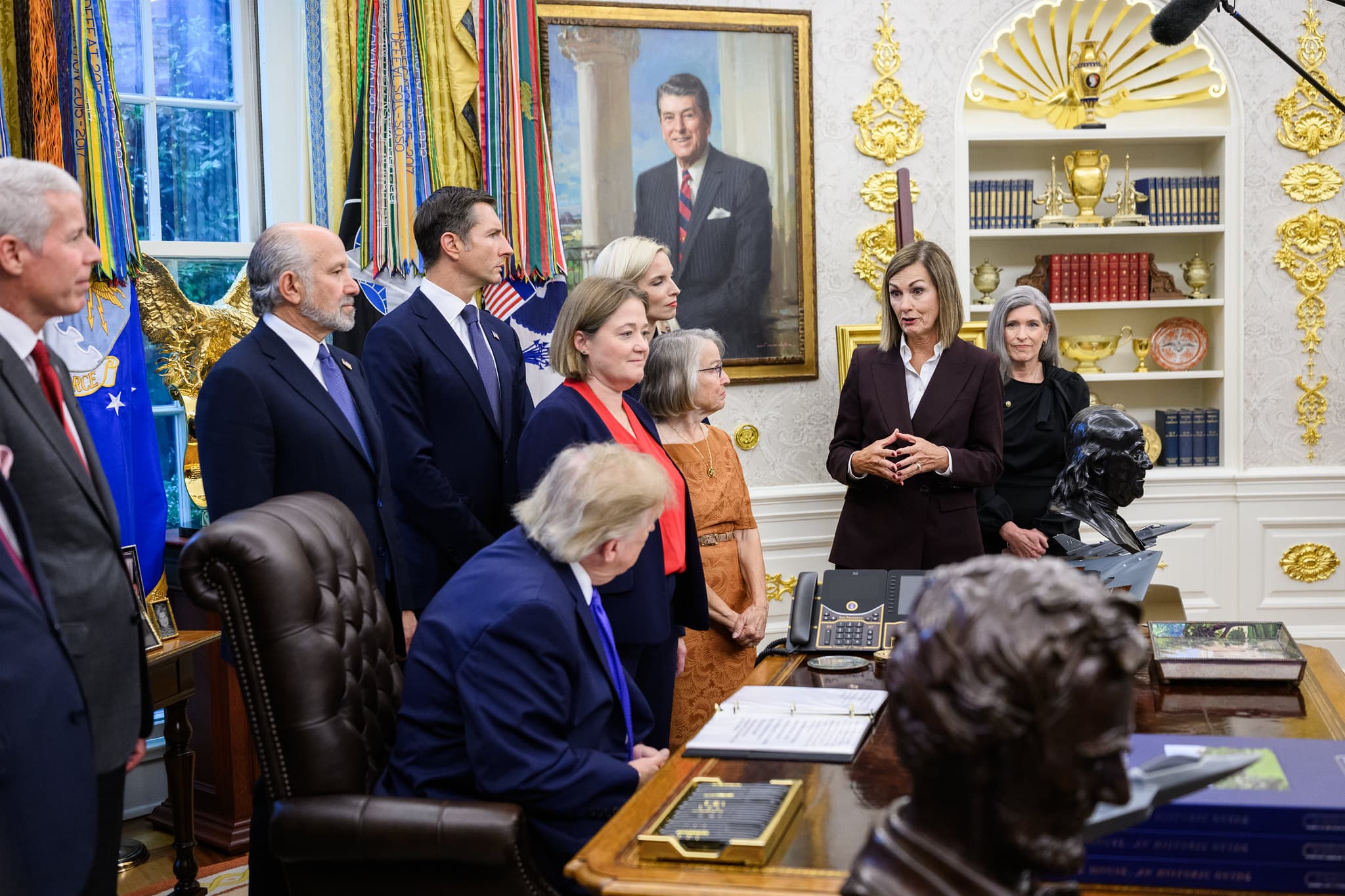
President Donald Trump announced Tuesday that leading artificial intelligence executives signed a self-policing agreement he called a "constitution" and "morally binding." The accord, titled "The White House Accord on Superintelligence: A Joint Commitment on Frontier SI Responsibilities," emerged from a White House meeting.
House Speaker Mike Johnson, who attended, characterized the document as a "statement of principles" and "commitments that are voluntary on behalf of the industry." Johnson said the agreement outlines "robust internal controls and layers of internal and external review" by the participating companies.
Among the tech leaders present were Meta CEO Mark Zuckerberg, Elon Musk, Anthropic CEO Dario Amodei, Google CEO Sundar Pichai, Nvidia's Jensen Huang, Palantir's Alex Karp and Shyam Sankar, Amazon's Jeff Bezos and OpenAI's Greg Brockman. Cabinet members also attended.
The accord states that signatories "believe" each AI company "should implement" a series of controls and audits and emphasizes each company's individual responsibility to ensure its technology "builds trust with customers and the public." It does not codify formal laws or regulations.
Trump indicated the administration is considering forming an oversight committee, potentially comprising 10 individuals from the signatories, to "watch over the whole enterprise." He did not specify who would serve or if its decisions would be legally binding.
Speaker Johnson said Congress would continue to guide AI industry development in a safe manner but stopped short of announcing any specific congressional action to enforce the accord's principles.
Zuckerberg described the agreement as "a start and an accord that the whole industry could come to." The voluntary nature of the deal leaves the central question unresolved: how Trump plans to ensure compliance if a company chooses to ignore it.