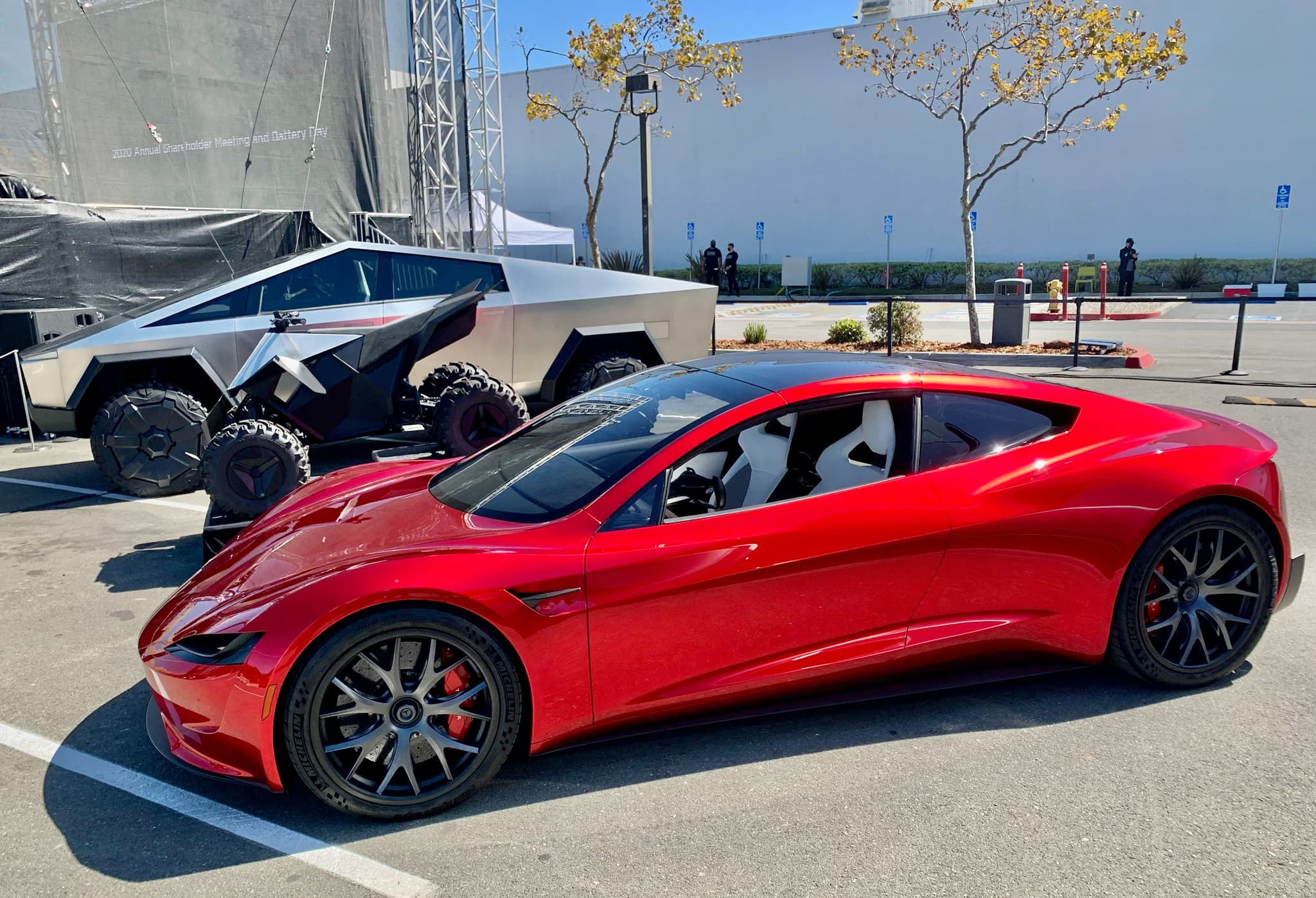
SAN FRANCISCO — Tesla is preparing to unveil its long-delayed next-generation Roadster as soon as this month, according to The Information, with a SpaceX-equipped variant that uses cold-gas thrusters to make the car float briefly. The cold-gas thruster feature is something CEO Elon Musk has discussed publicly for years as a defining capability of the new Roadster.
The original Roadster debuted in 2017—nine years before the expected unveiling date. That gap produced at least three distinct design directions that Tesla explored and ultimately rejected before arriving at whatever the final product looks like. The design process was far more turbulent than the company has publicly acknowledged.
Among the designs Tesla considered was a vehicle built on a repurposed Model S Plaid platform. The Model S Plaid, which starts at roughly the opposite end of the price spectrum from a halo sports car, uses a tri-motor setup capable of zero-to-60 in under two seconds. Using that existing architecture would have accelerated development timelines but risked producing a car that felt derivative rather than a clean-sheet flagship.
Tesla also explored an aesthetic borrowed from the Lamborghini Countach—the wedge-shaped Italian supercar that defined visual excess in the 1970s and 1980s—and a look inspired by the SR-71 Blackbird reconnaissance aircraft. Both references point to a design team that was searching for an identity, trying on radically different visual languages over at least several years.
Chief designer Franz von Holzhausen said earlier this year that the Roadster was coming soon. Musk had previously named April as a target unveiling month, then pushed it to May. Neither date produced an event. An August unveiling, if it holds, would be the third specific near-term target the company has set in 2026 alone.
The SpaceX thruster package is the product's clearest differentiator. Cold-gas thrusters generate thrust by expelling compressed gas—typically nitrogen—rather than burning fuel. Applied to a ground vehicle, they can create brief vertical or lateral lift. The technical challenge is integrating pressurized gas storage into a low-slung car body without compromising weight distribution or passenger safety. That integration problem, more than any design question, is the most plausible explanation for why development took as long as it did.
Tesla's stated goal for the Roadster has always been to build the fastest production car in the world, a position Musk described as non-negotiable from early in the program. The cold-gas system, if it functions as described, produces a capability no other street-legal production vehicle offers—which is exactly the kind of specification that justifies a nine-year development cycle to a company that treats product launches as marketing events.
The delay did real damage to Tesla's credibility on product timelines. Customers who placed deposits on the original Roadster announcement in 2017 have been waiting the better part of a decade. Tesla has not disclosed how many reservation holders remain or what deposit amounts are still held. The Roadster sits at the high end of the product line where it functions as a brand statement rather than a volume driver, which gives the company more tolerance for delay but also means the unveiling needs to deliver something genuinely extraordinary to justify the wait.
Tesla shares closed at $339.94 on Aug. 17, down 0.7 percent on the day. The stock has been under pressure in 2026 from margin compression on its core vehicle lines, and the Roadster unveiling—whenever it happens—will be watched as a signal of whether the company can still command premium positioning in a market where BYD, Porsche and others have closed the performance gap on conventional electric vehicles.
The timing of a potential August unveiling also puts it in close proximity to the company's ongoing Cybercab testing expansion, which now spans Texas, California, Nevada, Florida, Georgia and New York. Tesla is running two high-profile product narratives simultaneously, and a Roadster event this month gives the company a premium hardware story to run alongside its autonomous vehicle ambitions. Whether the final design bears any resemblance to the 2017 prototype, the Countach sketch or the SR-71 inspiration will be answered at the event itself.


