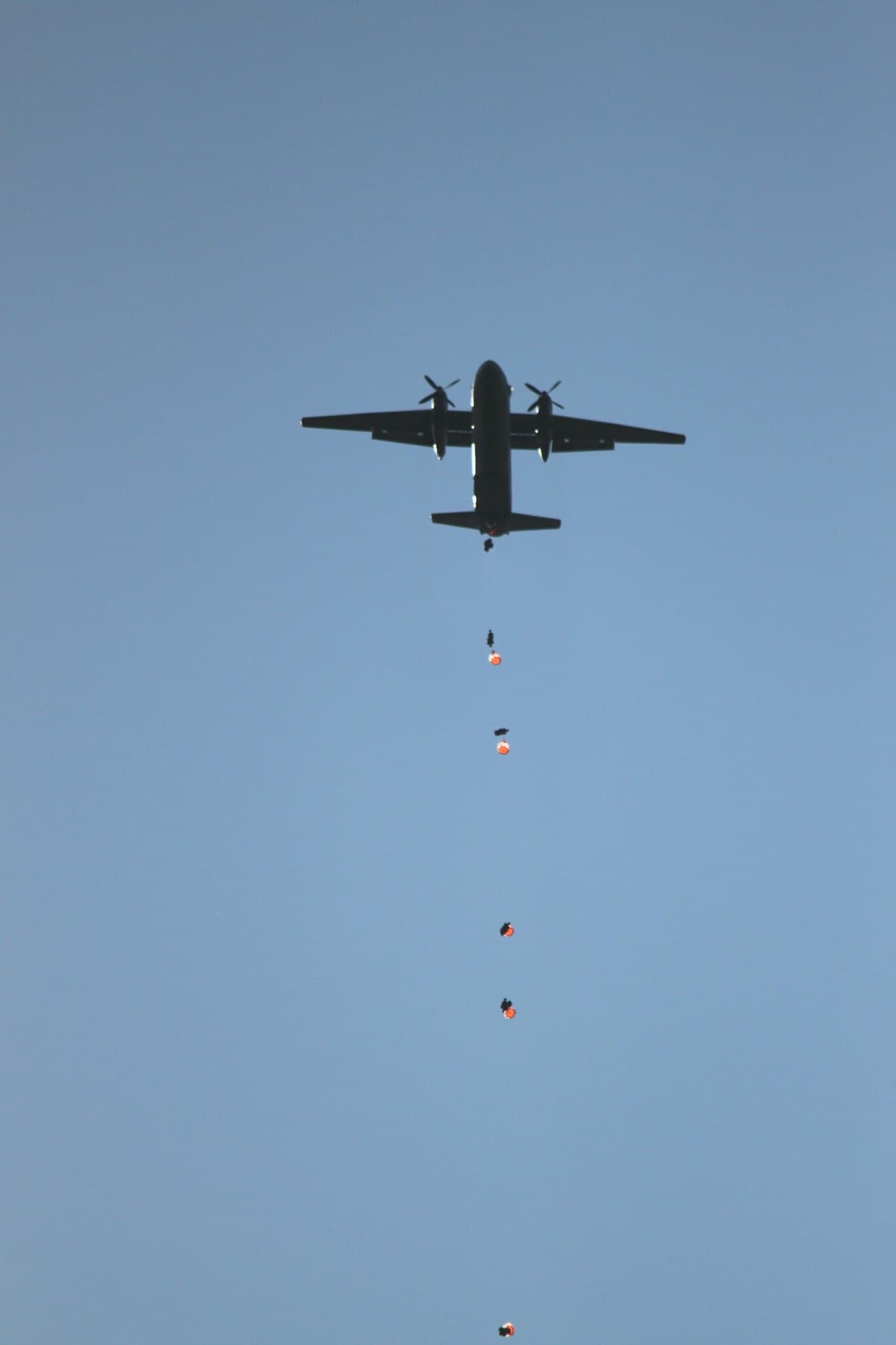
On a frost-edged August morning in central Ukraine, a few hundred newly graduated paratroopers moved across a corn and rapeseed field, gear strapped to their backs, preparing for their first jump. It was a scene from a different era of warfare — and the soldiers training them know it.
Ukraine's defence ministry reported in July that roughly 90 percent of targets on the front are now destroyed by drones. Ground robots are being integrated into combat missions, both to fight and to resupply troops pinned in dangerous positions. The classic picture of infantry at the front and aircraft in the air has become, in the words of those fighting the war, increasingly obsolete.
"Airdropping personnel with parachute systems is impractical because, unfortunately, the enemy's assets can neutralize them very rapidly," said Axel, a 24-year-old instructor at the training site. Parachute drops behind enemy lines, once central to airborne operations since World War II, have no practical role in the current fight against Russia.
Roman Kulievych, a young officer present at the training, was direct about it. "Parachute jumps behind enemy lines are not practical at all in modern warfare," he said. The tradition endures because "it forges character, one that sets us apart from other branches of the armed forces."
The training is designed to test the limits of that character. Candidates must complete a forced march through sand and swamps, surrounded by constant explosions, gunfire and the shouts of instructors. At the finish, each candidate fights hand-to-hand against three experienced paratroopers in succession. The exercise is the final requirement to earn the paratrooper's beret.
Axel described the purpose plainly: "It is essentially part of psychological training: this way we understand if the personnel are ready for stressful situations and how they fight their fears." For soldiers who will face an unseen enemy operating a drone from kilometres away, instructors say the mental preparation that traditional training provides matters more than the physical skills themselves.
Karyi, a 21-year-old recruit who uses that callsign, said: "It shapes your psyche and moulds your motivation to fight, so that in critical situations, you know you are capable of something more." He acknowledged the direction technology is taking the battlefield. "I'd love to see artificial intelligence winning wars, liberating territories," he said — but stopped short of believing machines have made soldiers irrelevant.
Yuriy, a senior instructor, drew the clearest line. Maybe one day "only techies will do the fighting," he said. "But still, territory is only held by a unit when actual units are standing there — meaning people, not robots."
That distinction has been tested in practice. Ukraine's Third Separate Assault Brigade operates a unit designated NC13, which handles ground-based robotic strike systems. The unit has conducted missions in which ground robots and drones stormed enemy positions and took prisoners without infantry involvement — what its personnel describe as the first operations of that kind in recorded military history. Since those initial operations, missions in which robots replace human soldiers have become routine for the unit. Even so, holding and administering captured ground still requires soldiers present.
For many troops at the front, the dominant threat is no longer another soldier charging across open ground. It is an operator sitting far from the fighting, guiding a drone with a joystick toward a position the target may never see coming. Ukraine's instructors say that shift makes the mental demands on conventional soldiers greater, not smaller, because there is no visible adversary to orient against and no rotation schedule offering relief.
The newly trained paratroopers completing their jumps in central Ukraine will be assigned the same mission that has defined Ukrainian ground forces for four years: hold the front line and push back the Russian advance. The airborne insignia they earn carries the history of elite operations stretching back to World War II. The war they are entering runs on sensors, algorithms and remotely piloted machines. Both things are true at once, and Ukraine's military is training for both.