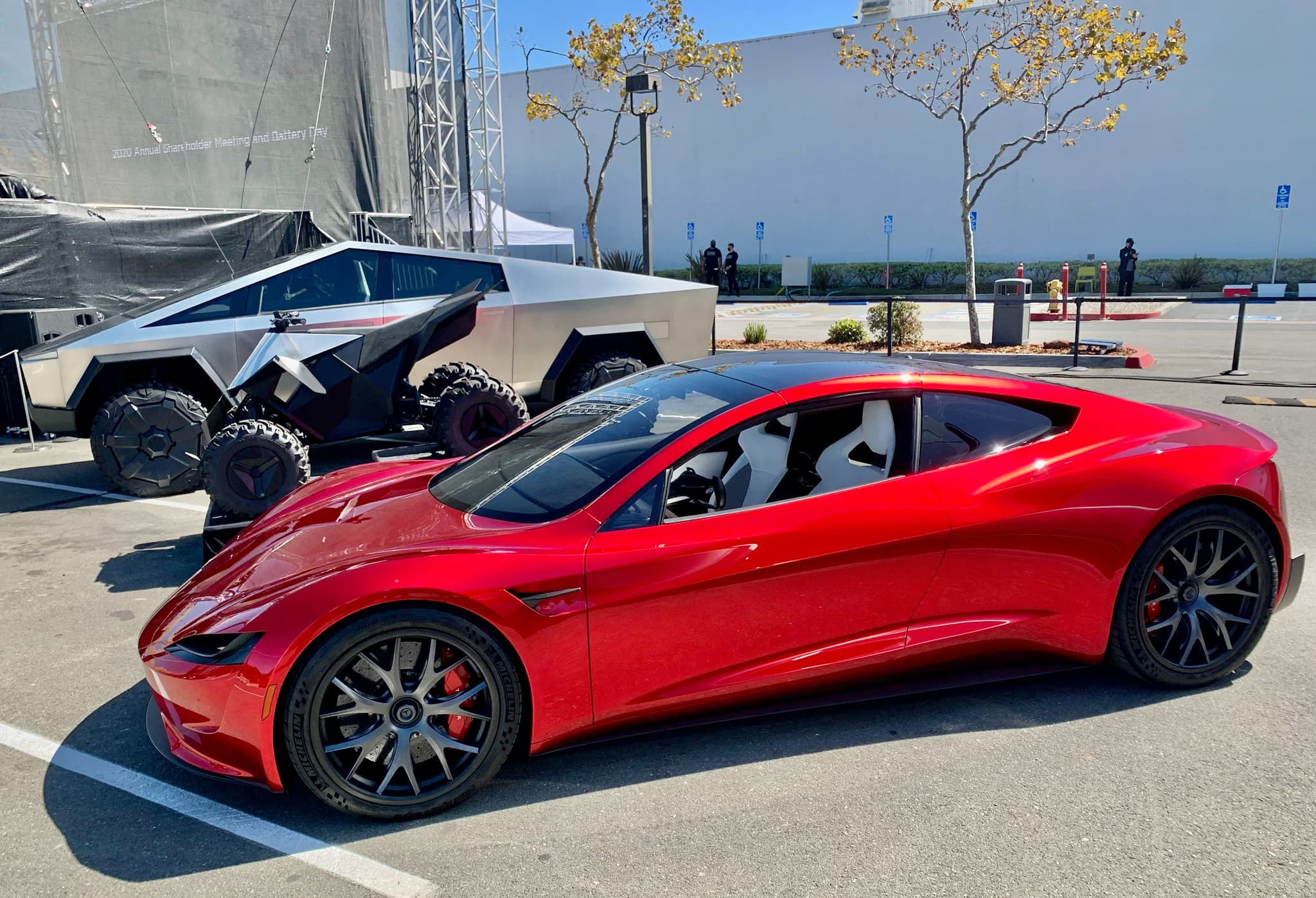
SAN FRANCISCO — The Information reports Tesla could unveil the next-generation Roadster as soon as August 2026, a car it first showed the world in 2017 and has been promising to deliver ever since. The unveiling, if it holds, would end a nine-year wait and introduce a SpaceX-integrated version equipped with cold-gas thrusters capable of lifting the vehicle off the ground for brief periods.
CEO Elon Musk has discussed the thruster concept publicly for years, framing it as the feature that would separate the Roadster from every other performance car on the market. The cold-gas thruster system, developed with SpaceX hardware, works by expelling compressed gas at high pressure to generate short bursts of lift or acceleration—the same basic physics behind spacecraft attitude control, adapted for a street vehicle. Whether a thruster-equipped car can clear regulatory hurdles for road use in the United States is an open question the company has not addressed publicly.
The design history behind the car is as complicated as its timeline. During the extended development period, Tesla considered scrapping the aesthetic it debuted in 2017 entirely. One option under review was a repurposed Model S Plaid—Tesla's existing flagship performance sedan—reworked into a roadster body. A second direction drew inspiration from the Lamborghini Countach, the angular Italian supercar that defined 1970s performance car design. Neither direction is the design Tesla plans to show.
The 2017 prototype Musk unveiled at a Semi reveal event in Hawthorne, California, carried specs that were aggressive even by today's standards: a claimed 0-to-60 time under 1.9 seconds, a top speed above 250 miles per hour and a 620-mile range on a single charge. Those figures were never independently validated, and no production timeline was ever formally committed. Tesla collected reservations—reported at the time at $50,000 for the Founders Series—but has not publicly disclosed how many reservation holders remain active after nearly a decade.
The months leading into August 2026 produced a string of near-misses on reveal timing. Musk said the event would happen in April. It did not. Chief Designer Franz von Holzhausen said in subsequent public comments that the car was coming soon. It still had not appeared as of the end of July. The pattern fits a broader tendency at Tesla to announce hardware milestones with optimistic dates and then adjust—the Cybertruck, the Semi and Full Self-Driving all shipped years behind their original schedules.
The Roadster occupies a different strategic position than those vehicles. It is not a volume product. Tesla sold roughly 1.77 million vehicles in 2023, its best year to date, and the Roadster will not contribute meaningfully to that count. Its value to the company is brand positioning: a halo vehicle that demonstrates the outer edge of what Tesla's engineering can do, in the same way the original 2008 Roadster established the company's credibility before the Model S existed.
The SpaceX integration angle adds a dimension no other automaker can replicate. SpaceX is a private company with no obligation to license its propulsion technology to rivals, and Musk controls both entities. That exclusivity, combined with the engineering complexity of building thruster hardware into a road car, makes the SpaceX Roadster version effectively un-copyable in the near term. Whether consumers will pay a premium for a car that hovers for a few seconds is a separate question from whether the technology works.
Tesla's stock trades at $342.27 as of Aug. 16, up 0.7 percent on the day. The share price has not historically moved on Roadster news alone—the car's production scale is too small to affect revenue projections—but a successful reveal would feed a broader narrative about Musk's engineering ambitions at a time when Tesla's core EV business faces intensifying competition from BYD, Rivian and a wave of Chinese manufacturers.
On the product side, Tesla also launched a Vehicle-to-Load Outlet Adapter for Premium Model Y vehicles in the United States this month, giving owners the ability to power external devices directly from the car's battery pack. The capability applies to Juniper Model Y trims only—the company's current-generation Model Y—and does not extend to first-generation Model Y vehicles regardless of trim level.
The Roadster reveal, if it happens in August, will be the second public showing of the car in nine years. The first was a surprise: Musk rolled it off the back of a Semi truck at a product event in November 2017. The second will carry the full weight of an audience that has been waiting ever since.


