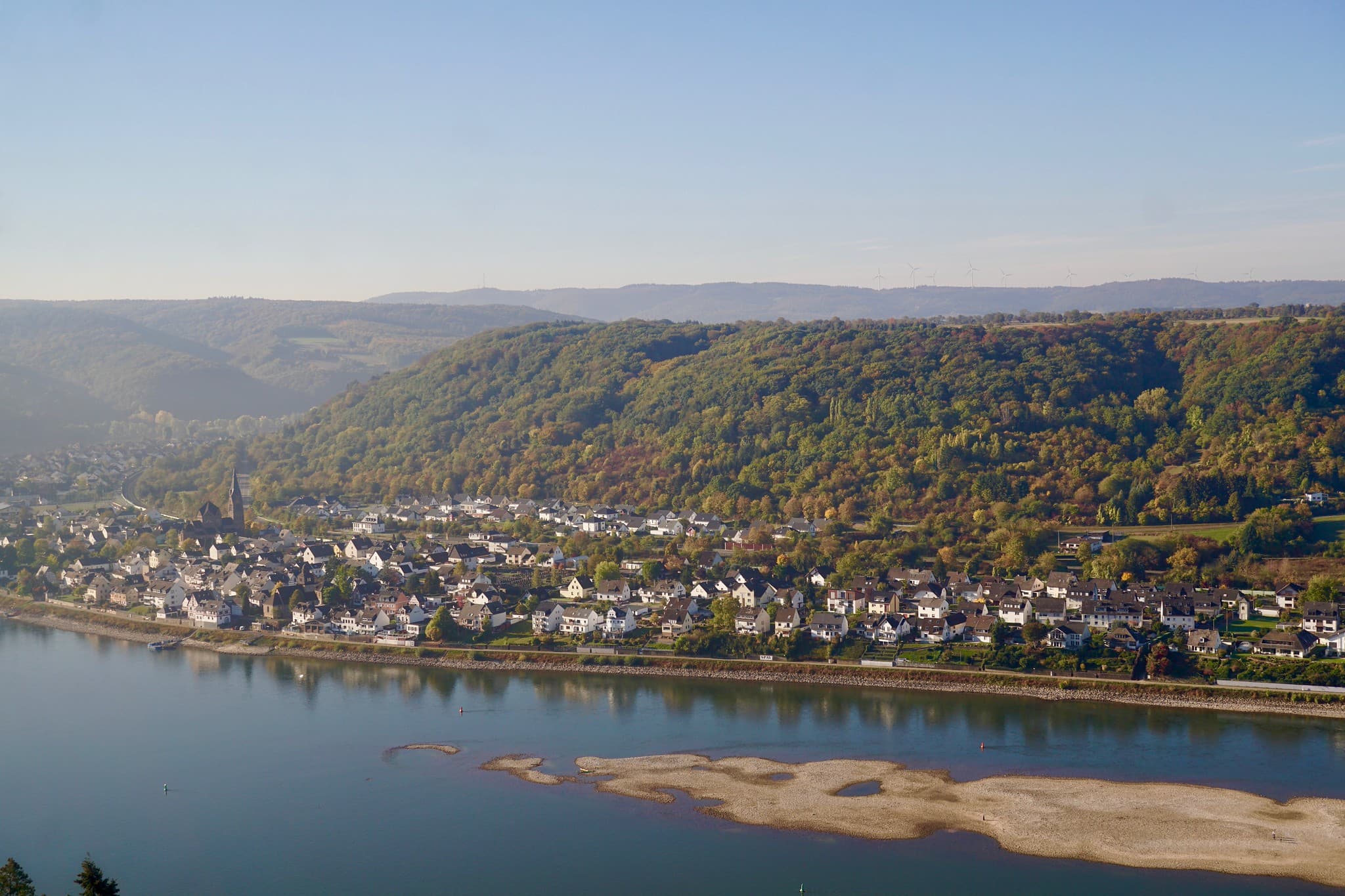
BERLIN — The water level at Kaub, the critical measurement point on the Rhine where the river narrows between cliffs south of Koblenz, dropped to 24 centimeters Monday, breaking a record that had stood since at least 1880. The previous low of 25 centimeters was set in Oct. 2018. That difference of a single centimeter carries economic weight: the 2018 drought, which struck in autumn, cost Germany an estimated 0.3 to 0.4 percent of GDP. This year's record has arrived in the middle of summer, and weather forecasts for the next two weeks show little rainfall ahead.
The German Economic Institute, known by its German initials IW, now estimates the current drought will reduce gross domestic product by 0.4 percent — enough to erase what had been forecast as the entirety of Germany's economic growth for the year. That projection carries additional weight because the river's condition is expected to deteriorate further before it improves.
The Rhine is not simply a transport option for German industry. Roughly 285 million tonnes of freight move along the river each year, making it Europe's most important inland logistics corridor. It carries around 80 percent of all goods transported on Germany's inland waterways, and approximately 600 vessels cross the Dutch-German border on any given day.
The corridor connects the port of Rotterdam directly to three of Germany's largest industrial clusters: the Rhine-Ruhr steel region, the Rhine-Main financial and manufacturing hub, and the Ludwigshafen chemical complex, home to BASF's main production site. Those facilities were built beside the river in the 19th century to use barge transport and draw process water from the river. Their physical footprint has not changed.
When water falls below navigable thresholds, barges cannot carry full loads — or cannot operate at all. Replacing a single fully loaded barge requires up to 100 trucks or an entire freight train. Germany's road and rail networks, already strained by years of underinvestment and aging infrastructure, cannot substitute for Rhine capacity at scale.
During the 2018 episode, a full month of sharply reduced water levels cut inland shipping volumes by roughly a quarter and pushed industrial production down by approximately 1 percent. The cumulative drag on growth that year came to between 0.3 and 0.4 percentage points of GDP, depending on the estimate. The key difference in 2026 is timing: low water in autumn is a known seasonal risk that industry plans around. A record low in August, with two months of the typical low-water season still ahead, is not.
German industry has not been passive in the face of recurring drought. Shipping companies have built shallower-draft barges capable of operating at lower water levels, and major manufacturers along the corridor have raised their inventory holdings to buffer against supply disruptions. But those measures reduce exposure — they do not eliminate it. Shallower barges carry smaller loads, and higher inventories tie up capital.
The Rhine accounts for roughly 6 percent of Germany's total freight volume. The economic damage from its disruption runs well above that proportion because of the specific industries concentrated along its banks. Chemicals, steel and heavy manufacturing — all sectors with tight logistics tolerances and high input volumes — depend on the river in ways that road or rail cannot easily replace.
The 2018 drought was not an isolated event. Severe low-water periods also struck in 2022, establishing a pattern of more frequent and longer stretches of lost navigability. ING economist Rico Luman published analysis this week on the supply-chain consequences of the current episode. The broader research makes clear that the economic cost function is nonlinear: damage rises steeply as water levels fall below the point where even shallow-draft barges must reduce loads.
Germany entered 2026 already carrying the weight of a prolonged industrial slowdown. Manufacturing output has contracted for much of the past two years under pressure from high energy costs, weak export demand from China and structural shifts away from combustion-engine vehicle production. An additional drag of 0.4 percentage points — wiping out projected growth entirely, in the IW's assessment — arrives at a moment when the economy has limited room to absorb shocks.
Until precipitation returns in sufficient volume to raise the Kaub gauge above navigable thresholds, every additional day of low water deepens the supply constraint on Rhine-dependent production. The season in which that typically happens has not yet begun.