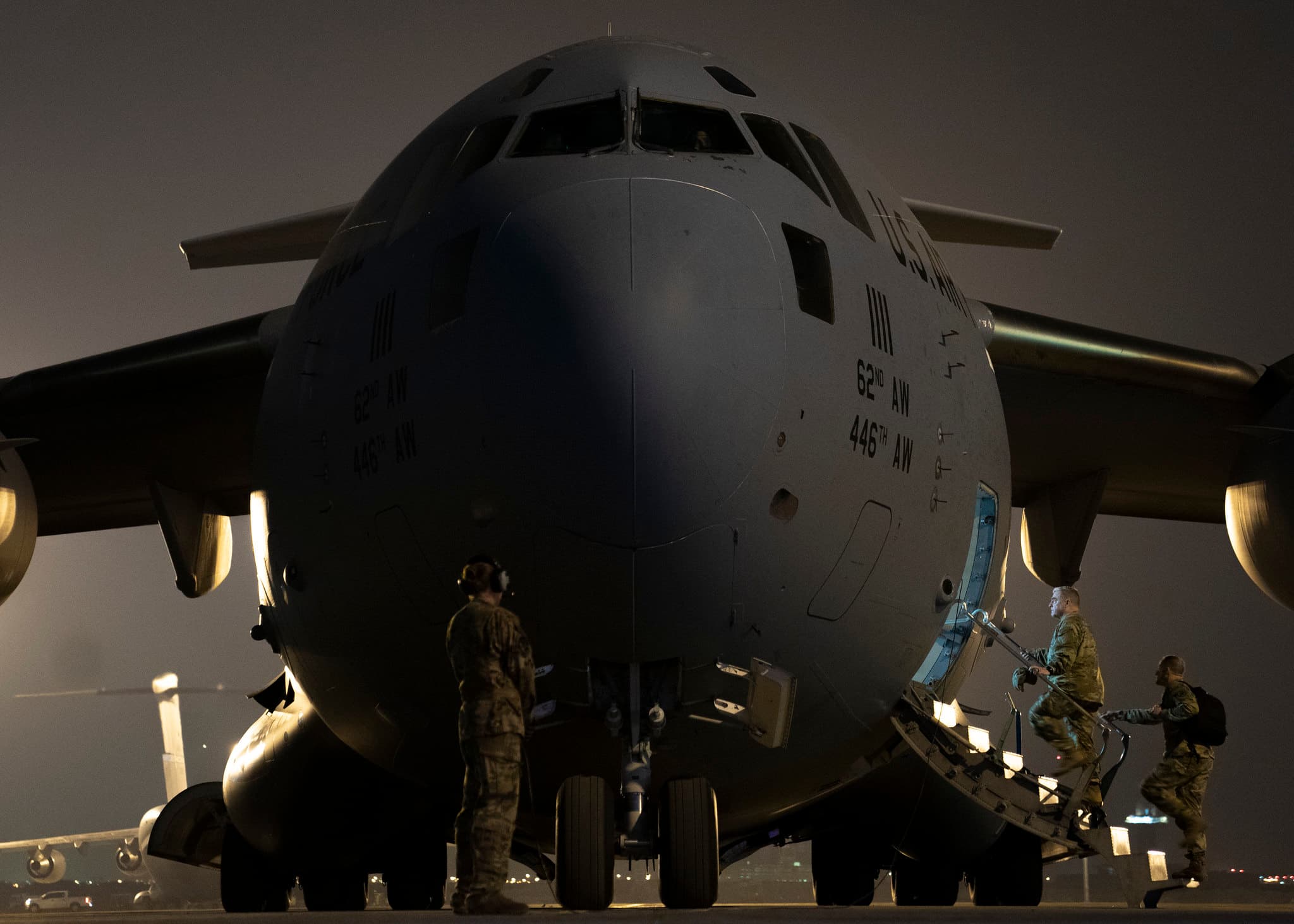
ARABIAN SEA — Adm. Brad Coo commander of U.S. Central Command, boarded the USS Abraham Lincoln on Feb. 7 as the Nimitz-class aircraft carrier moved through the Arabian Sea on a scheduled deployment. The visit came at the end of a 10-day regional tour in which Cooper traveled to six countries across the Middle East.
Cooper was joined on the carrier by U.S. Special Envoy for Peace Missions Steve Witkoff and Jared Kushner. The two civilian officials met with the ship's sailors and Marines. Cooper said in a statement released by CENTCOM: "I join the American people in expressing our incredible pride in the Sailors and Marines of the Abraham Lincoln Carrier Strike Group. Their dedication to the mission and professionalism are on full display here in the Middle East as they demonstrate U.S. military readiness and strength."
The Abraham Lincoln departed its home port of San Diego in November and first operated in the Indo-Pacific before repositioning to the Middle East in January. The strike group includes, alongside the carrier itself, the staffs of Carrier Strike Group 3, Destroyer Squadron 21 and Carrier Air Wing 9, as well as guided-missile destroyers USS Frank E. Petersen Jr. USS Spruance and USS Michael Murphy. More than 60 fixed-wing and rotary-wing aircraft operate off the ship.
Cooper's Feb. 7 visit placed him at the center of a pressure campaign against Iran already under way. The day before, on Feb. 6, Cooper was present at indirect negotiations in Muscat, Oman — his attendance a deliberate signal, noted by the Center for Strategic and International Studies, that the Abraham Lincoln was operating just offshore. The carrier's position in the Arabian Sea gave those diplomatic talks a hard military backdrop.
The trajectory from that point moved quickly. On Feb. 26, Cooper and Gen. Dan Caine, chairman of the Joint Chiefs of Staff, briefed President Trump on military options concerning Iran. Two days later, on Feb. 28, Cooper ordered U.S. airstrikes on Iran on Trump's instruction, making him the operational commander of the first direct U.S. military action against the country.
The broader deployment numbers reflect the scale of the U.S. presence Cooper was overseeing during his tour. More than 50,000 American service members were deployed across the Middle East at the time of his regional visit — a figure that reflects the CENTCOM area of responsibility stretching from Egypt to Central Asia.
The Abraham Lincoln Carrier Strike Group was operating in that theater in a maritime security role, with CENTCOM describing its mission as supporting stability in the region. The strike group's positioning in the Arabian Sea placed it near the Strait of Hormuz, the narrow waterway through which a significant share of global oil shipments pass and which Iran had repeatedly threatened to close in the months prior.
Cooper's biography tracks closely with the region he commands. Before taking over CENTCOM, he served as the command's deputy commander, and he spent years in Bahrain — the home of the U.S. Navy's 5th Fleet — giving him direct familiarity with the Gulf's military geography and its network of partner governments. That background shaped his approach to the February diplomatic and military pressure sequence.
The Feb. 7 carrier visit was the public-facing moment of a trip that covered six countries. Cooper's stops were not individually enumerated in official CENTCOM releases, but the scope of the tour — six nations in 10 days — put him in contact with a wide range of Gulf partners at a moment when the United States was preparing the diplomatic groundwork that preceded the late-February military escalation.
Witkoff's presence alongside Kushner on the Abraham Lincoln added a political dimension to what CENTCOM framed as a morale visit. Witkoff, in his role as special envoy for peace missions, had been engaged in the broader Iran negotiation track, and his appearance on the carrier alongside the theater commander illustrated how closely the civilian diplomatic effort and the military posture were being coordinated at the time.


