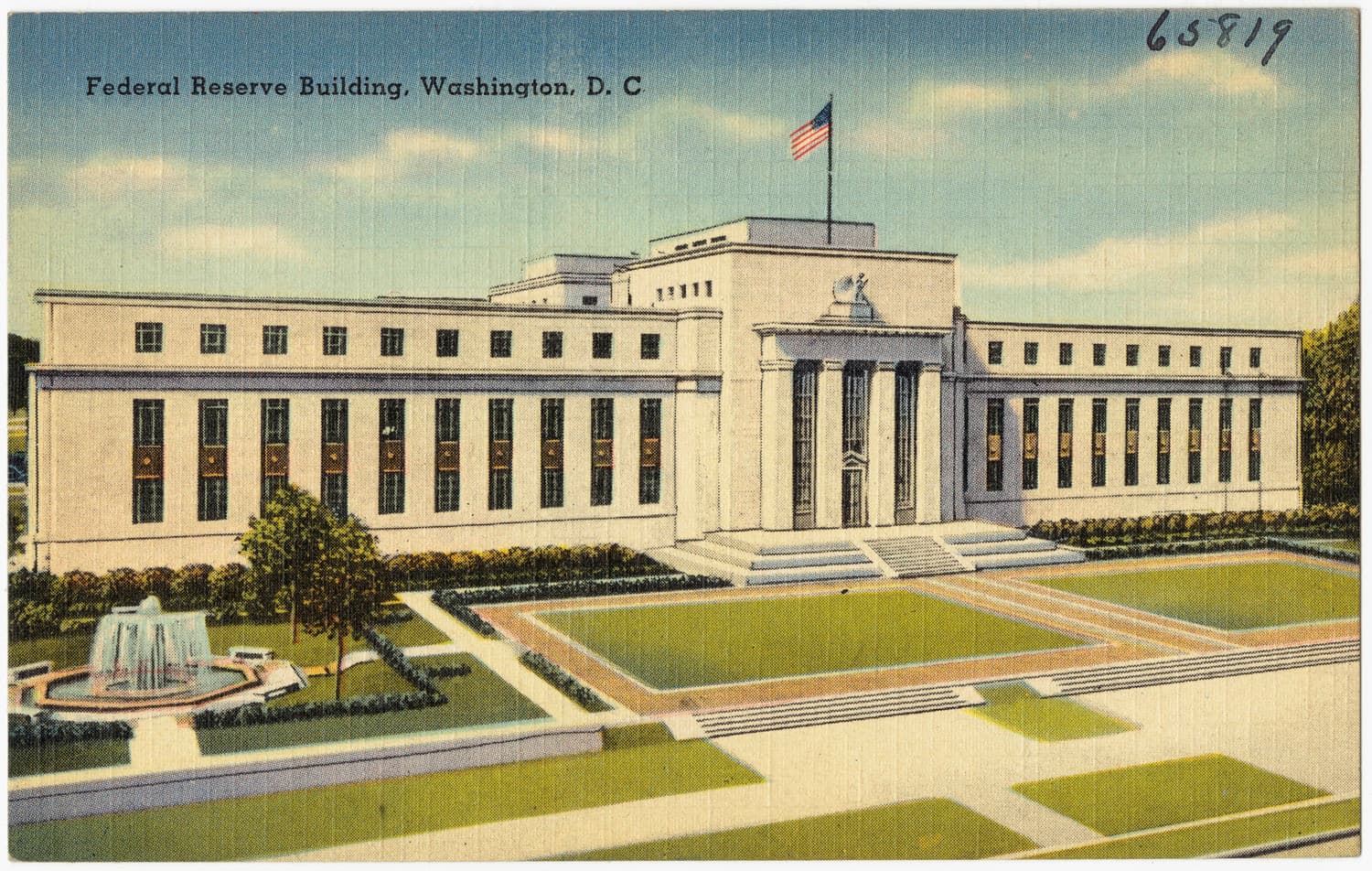
President Donald Trump today issued a direct challenge to the independence of the Federal Reserve, publicly threatening to fire Chair Jerome Powell and refusing to halt any ongoing criminal probe related to the central bank's leadership. These statements, delivered in a public address, mark a significant escalation in the administration's pressure on the nation's monetary authority, injecting profound uncertainty into the financial markets. Such explicit political intervention into the Fed's operational autonomy is a rarity, immediately raising concerns among fixed-income participants about the future trajectory of interest rates and the central bank's ability to maintain price stability.
The initial market reaction, while not fully crystallized in today's closing figures, points towards significant future volatility. While the S&P 500 closed up 0.3 percent at $6,989 and the Nasdaq gained 0.8 percent to reach $23,824, the President's remarks are expected to trigger sharp movements in the bond market. Treasury yields are anticipated to spike across the curve as investors demand a higher risk premium for holding U.S. government debt amid policy uncertainty. The U.S. Dollar Index would likely weaken as capital seeks stability in less politically contentious jurisdictions, while gold, a traditional safe haven, would rally. Bitcoin, currently trading at $73,923, and Ethereum at $2,341, would face heightened volatility, caught between a flight-to-quality narrative and broader risk-off sentiment.
Historically, central bank independence has been a cornerstone of economic stability in developed nations, safeguarding monetary policy from short-term political exigencies. While U.S. presidents have often criticized the Federal Reserve, direct threats to the Chair's tenure or the institution's operational integrity are exceedingly rare and carry substantial historical weight. Past instances of perceived political pressure, such as President Lyndon Johnson's interactions with Fed Chair William McChesney Martin or President Richard Nixon's influence over Arthur Burns, often preceded periods of elevated inflation or market instability. This current confrontation, however, is more explicit and public, directly challenging the institutional framework that has underpinned decades of U.S. economic policy.
From the Federal Reserve's perspective, Chair Powell and the Federal Open Market Committee are expected to staunchly defend the institution's dual mandate of maximum employment and price stability, free from political interference. The Fed's credibility, painstakingly built over decades, hinges on its perceived independence. Any erosion of this autonomy could undermine its ability to effectively manage inflation expectations and guide the economy through business cycles. Other global central banks, including the European Central Bank and the Bank of Japan, would be closely monitoring the situation, as a politically compromised Fed could have significant spillover effects on global financial stability and cross-border capital flows, potentially sparking a flight from dollar-denominated assets.
The fixed-income market would immediately grapple with the implications for the yield curve and credit spreads. Should the market perceive that political interference will lead to a more accommodative monetary policy or increased fiscal dominance, the Treasury yield curve would likely steepen significantly, with long-term yields rising disproportionately to compensate for higher expected inflation. Credit spreads on corporate bonds, both investment grade and high yield, would widen sharply as investors price in greater uncertainty and a higher probability of economic instability. Duration risk would become a paramount concern, forcing portfolio managers at institutions like BlackRock and Vanguard to aggressively shorten their bond exposures to mitigate potential capital losses from rising rates.
Cross-asset implications extend far beyond the bond market. Equities, despite today's modest gains with the S&P 500 closing up 0.3 percent at $6,989 and the Nasdaq up 0.8 percent at $23,824, would face significant headwinds. The Dow Jones, already down 0.4 percent at $48,340, could see further declines as investors price in a higher equity risk premium. Technology giants like Apple, up 2.5 percent to $265.36, and Microsoft, up 3.8 percent to $408.01, could see their valuations pressured by rising discount rates and increased systemic risk. Tesla, which gained 6.4 percent to $387.41 today, would face similar challenges. In the crypto markets, Bitcoin, currently at $73,923, and Ethereum, at $2,341, would navigate extreme volatility, with the Crypto Fear & Greed Index, currently at 23 (Extreme Fear), reflecting heightened investor anxiety. Commodities, particularly gold, would likely benefit from safe-haven flows.
Looking forward, the market's attention will turn to any official response from the Federal Reserve and whether President Trump's threats translate into concrete action. Upcoming economic data releases, including the next Consumer Price Index and employment figures, will be scrutinized not only for their inherent economic signals but also for how they might be leveraged in the political debate over monetary policy. The next Federal Open Market Committee meeting will be a crucial test of the Fed's resolve and independence. Scenarios range from Powell's steadfast resistance, potentially escalating the political standoff, to an unprecedented capitulation, which would fundamentally alter the landscape of U.S. monetary policy for decades.
The bottom line for Gokhshtein Media is unambiguous: President Trump's direct challenge to Federal Reserve Chair Powell represents a material and unprecedented risk to U.S. financial market stability and the global perception of dollar-denominated assets. The erosion of central bank independence introduces a layer of unpredictable political risk into monetary policy decisions, fundamentally altering the calculus for fixed-income investors. This event demands a significant re-evaluation of duration exposure, credit risk, and overall portfolio positioning, as the very foundation of predictable monetary policy has been called into question. The market will demand a substantial premium for this newfound uncertainty, impacting everything from Treasury yields to corporate bond spreads and equity valuations for the foreseeable future.


