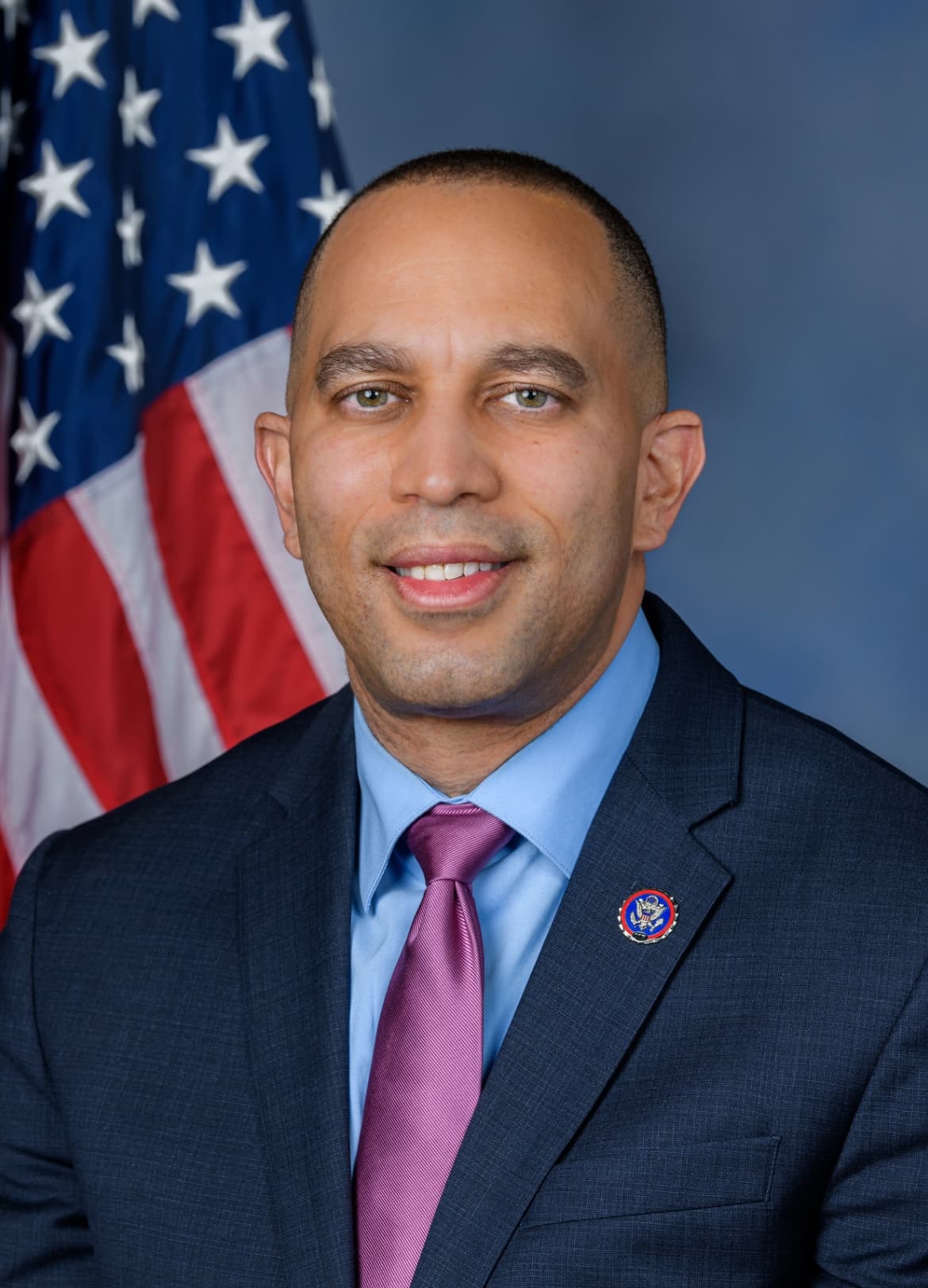
House Minority Leader Hakeem Jeffries' abrupt call for Speaker Mike Johnson to cut short the ongoing House recess and address the lapse in Department of Homeland Security (DHS) funding has thrust Washington into another high-stakes appropriations battle, sending ripples of uncertainty through federal contracting circles and raising concerns among investors. This strategic maneuver by Democrats aims to put immediate pressure on Speaker Johnson and the fractured Republican caucus, forcing a public confrontation over border policy and government spending. While direct market fallout from a mere call for reconvening is not immediate, the specter of a potential partial government shutdown or prolonged funding impasse adds a layer of risk to an already volatile economic landscape, particularly for companies with significant government contracts.
The financial markets, currently navigating a complex mix of geopolitical tensions and evolving monetary policy, responded with a degree of caution to the renewed political gridlock. The Dow Jones edged down slightly to $46,505, while the S&P 500 and Nasdaq saw modest gains, closing at $6,583 and $21,879 respectively. In the crypto sector, Bitcoin demonstrated resilience, trading at $69,162, a 3.1% increase over 24 hours, with Ethereum also gaining 3.8% to reach $2,135. However, the broader sentiment in the digital asset space remains one of "Extreme Fear," as indicated by the Crypto Fear & Greed Index at 13, suggesting that underlying investor anxiety persists despite short-term rallies. This political brinkmanship on Capitol Hill only exacerbates that fear, as legislative uncertainty often translates to investment hesitancy across all asset classes, including the burgeoning digital economy.
This latest skirmish over DHS funding is not an isolated incident but rather another chapter in the protracted legislative struggle that has characterized the 119th Congress. It underscores the deep ideological chasm between the two parties, particularly on issues of border security, immigration, and federal spending priorities. Speaker Johnson faces the perennial challenge of uniting his slim and often fractious Republican majority, which includes a vocal conservative wing demanding stricter border measures and fiscal austerity. Meanwhile, Democrats, led by Jeffries, are seizing the opportunity to highlight what they perceive as Republican dysfunction and to push for a more comprehensive, bipartisan solution to government funding, linking it to broader economic stability. The appropriations process, once a routine function of government, has become a primary battleground for political leverage, consistently delaying critical legislative initiatives and creating a climate of perpetual fiscal uncertainty.
Key stakeholders on K Street are already mobilizing, with lobbyists representing various interests closely monitoring the situation. Major defense and security contractors, such as Lockheed Martin, Raytheon Technologies, and particularly those specializing in border technology like Leidos and Palantir Technologies, face direct financial implications from any funding lapse. These firms rely heavily on federal contracts, and any disruption to DHS appropriations can lead to project delays, payment freezes, and a cascade of operational challenges. Lobbying groups representing these companies, including the Aerospace Industries Association and various K Street powerhouses like Akin Gump Strauss Hauer & Feld and Holland & Knight, have been actively engaging lawmakers to advocate for stable and predictable government funding. For them, Jeffries' call is a stark reminder of the financial risks inherent in Washington's political theater, as the potential for a shutdown directly impacts their bottom lines and investor confidence in their future earnings.
The industry impact of this political posturing extends beyond just direct government contractors. A prolonged funding lapse for DHS could disrupt critical federal operations, including customs and border protection, immigration services, and even some cybersecurity initiatives that fall under the department's purview. This ripple effect could impact logistics companies, travel and tourism sectors, and any business reliant on the efficient functioning of cross-border trade. For the financial sector, persistent government instability can dampen investor confidence, increase the cost of capital, and complicate long-term strategic planning. Furthermore, the legislative gridlock over appropriations often stalls progress on other crucial financial regulation, including the long-awaited stablecoin legislation and broader market structure reforms for digital assets. The inability of Congress to pass basic funding bills signals a broader dysfunction that makes consensus on complex financial innovation nearly impossible, leaving firms like Circle, Tether, and various crypto exchanges in regulatory limbo.
From a legal and operational standpoint, the precedent set by previous government shutdowns highlights the significant compliance costs and operational headaches for both federal agencies and the private entities they regulate or contract with. Essential personnel at DHS, including border patrol agents and TSA officers, would be required to work without pay, leading to morale issues and potential service disruptions. Non-essential functions would cease entirely, impacting data collection, permitting processes, and various administrative services. For financial institutions and crypto firms, a general climate of regulatory uncertainty created by a dysfunctional Congress can lead to increased compliance burdens as they try to anticipate and adapt to potential shifts in enforcement priorities or the lack of clear legislative guidance. Agencies like the SEC, currently led by Chair Paul Atkins, and FinCEN, which operates under the Treasury Department but collaborates closely with DHS on anti-money laundering efforts, rely on consistent funding and clear congressional mandates to effectively enforce regulations and provide clarity to the markets.
Looking forward, the immediate question is whether Speaker Johnson will cave to Jeffries' demand and reconvene the House, or if he will hold the line, waiting for the scheduled return. Regardless of the immediate response, the path to a permanent DHS funding solution remains fraught with peril. It will likely involve intense bipartisan negotiations, potentially leading to another stopgap continuing resolution or an omnibus spending package that bundles multiple appropriations bills. This ongoing battle over funding also casts a long shadow over other critical legislative priorities, including potential tax reforms, infrastructure spending, and, crucially for our audience, any substantive progress on digital asset legislation. As the 2026 midterm elections draw closer, the incentive for bipartisan compromise often diminishes, suggesting that political brinkmanship and short-term funding measures will continue to dominate the legislative agenda, pushing long-term solutions further out of reach.
The bottom line for Gokhshtein Media readers is clear: Jeffries' call to end the recess is a calculated political power play, designed to expose Republican divisions and force a public debate on border policy, rather than a genuine expectation of immediate legislative resolution. This maneuver signals that Washington's political gridlock is not easing but intensifying, with significant implications for market stability and regulatory predictability. For federal contractors, it means continued uncertainty and the need for robust contingency planning. For the broader financial markets, and particularly the crypto sector, it underscores the persistent legislative risk that impedes clear regulatory frameworks and slows innovation. As long as Congress remains mired in these partisan battles over basic government functions, the promise of a coherent, forward-looking financial regulatory environment, especially for digital assets, will remain just out of reach, forcing industry players to navigate a landscape defined by political volatility rather than clear policy.


