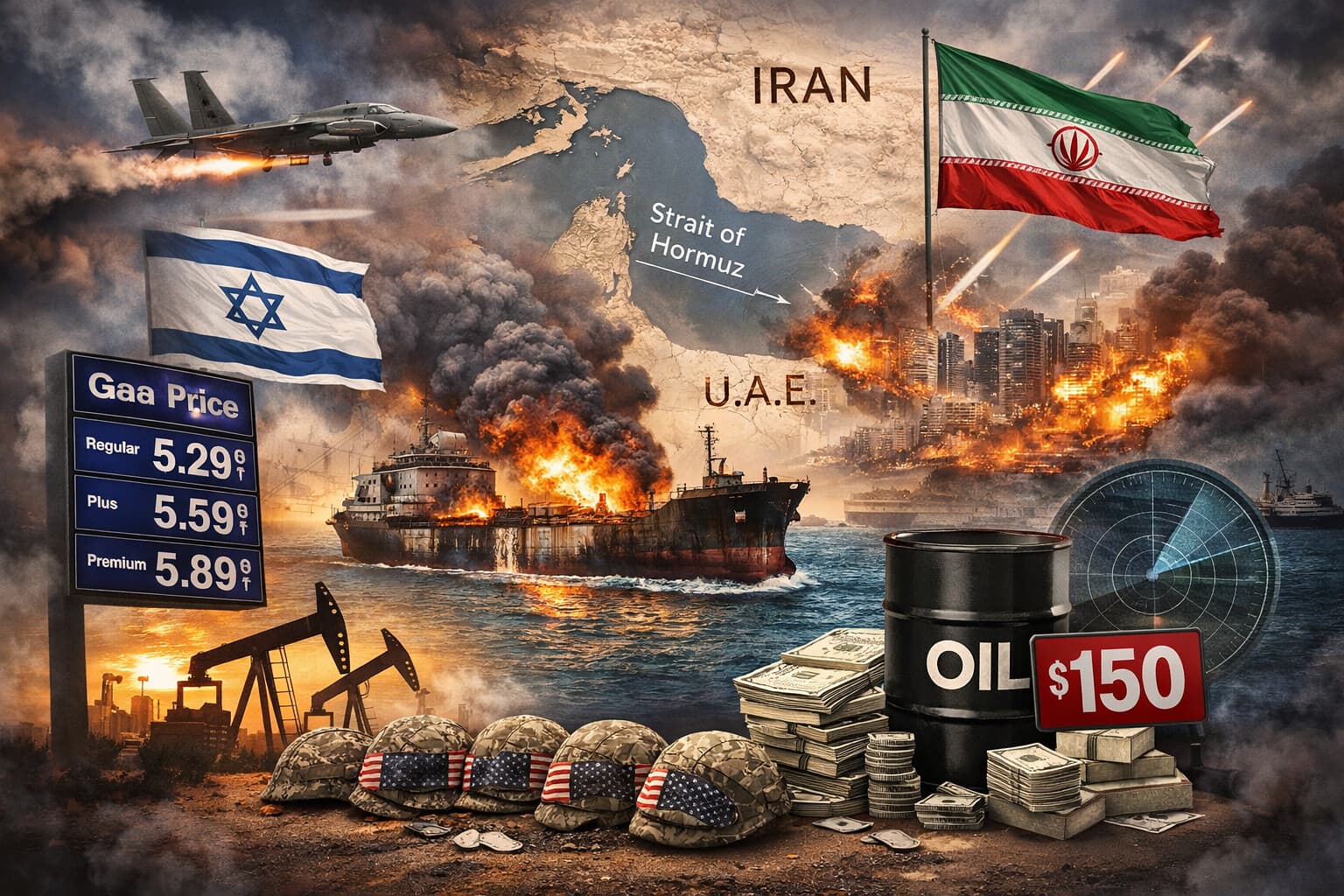
detailing Iran’s bolstered fortifications on critical small islands near the Strait of Hormuz marks a pivotal moment for global energy security, demanding an immediate re-evaluation of U.S. equity portfolios. This escalation directly enhances Iran's capacity to control the key waterway, a choke point for roughly one-fifth of global oil supply, and implies that any reopening of shipping lanes under duress would necessitate significant military intervention by U.S. or allied forces. The market's initial reaction, while seemingly muted across major indices with the S&P 500 up +0.1% at $6,583 and the Nasdaq gaining +0.2% to $21,879, belies a simmering undercurrent of re-pricing for geopolitical risk that sophisticated investors cannot ignore. This development fundamentally shifts the risk calculus for oil prices, maritime logistics, and the defense industrial base, setting the stage for substantial sector rotation. Investors must recognize the long-term implications of Iran's enhanced control, which transcends immediate supply disruptions and establishes a new baseline for regional instability and the cost of securing global trade routes.
While the broader market indices showed modest movement, with the Dow Jones slightly down -0.1% at $46,505 and the Russell 2000 up +0.7% at $2,530, a deeper look reveals nascent sector re-positioning. The immediate beneficiaries of such heightened geopolitical tension are invariably the defense and energy sectors, even if their specific stock prices are not yet reflecting the full impact of this news. Traders are now actively assessing the probability of a military response, or at minimum, a sustained increase in naval presence and security operations in the region, which directly translates to increased demand for defense contractors. Concurrently, the implied threat to oil transit through the Strait of Hormuz, regardless of actual disruption, introduces an immediate risk premium into crude futures, benefiting major integrated oil and gas producers. This dynamic suggests that capital is already beginning to flow out of more growth-oriented, risk-sensitive assets, evidenced by Tesla's significant -5.4% drop to $360.59 and Meta's -0.8% decline to $574.46, towards established safe havens and beneficiaries of conflict. The Crypto Fear & Greed Index at 9 (Extreme Fear) further underscores the pervasive risk aversion gripping the market, indicating investors are seeking tangible value and security over speculative bets.
Historically, periods of heightened geopolitical tension in critical energy-producing regions have consistently led to significant outperformance in the defense and energy sectors. From the Gulf Wars to more recent skirmishes in the Red Sea, markets have demonstrated a predictable flight to quality and a re-rating of companies directly involved in national security and resource extraction. The current situation around Hormuz, however, carries a distinct weight, as Iran's strategic fortifying of islands represents a pre-emptive power projection rather than a reactive measure, suggesting a more entrenched and prolonged standoff. This differs from transient disruptions; it signifies a structural shift in regional power dynamics that demands a sustained re-evaluation of energy supply chain resilience and defense readiness. The last time a similar level of strategic assertiveness was observed, it led to multi-year cycles of increased defense spending and elevated commodity prices, providing a clear playbook for today's sophisticated investor. We are entering a new phase where the underlying geopolitical risk premium for global oil supply is not merely transient but embedded for the foreseeable future, impacting long-term investment horizons.
Wall Street analysts and institutional funds are already recalibrating their models, recognizing the profound implications of Iran's strengthened position. Analysts at firms like JPMorgan and Goldman Sachs, who cover the global energy and defense sectors, are likely to upgrade their outlooks for companies with significant exposure to government contracts and upstream oil and gas production. Large institutional investors, including BlackRock and Vanguard, with their vast allocations, are poised to adjust their sector weightings, shifting capital into defense contractors such as Lockheed Martin and Raytheon Technologies, and major oil players like ExxonMobil and Chevron. Consensus estimates for defense spending are set to rise, driven by the imperative to secure global shipping lanes and project power, while energy price forecasts will incorporate a higher geopolitical risk premium. This strategic pivot is not speculative; it reflects a defensive realignment of capital in response to a tangible threat to global commerce and national interests, emphasizing resilience over pure growth metrics.
From a fundamental perspective, the implications for specific companies are clear and compelling. Defense contractors like Northrop Grumman and General Dynamics stand to benefit from increased U.S. and allied military budgets, translating into a robust pipeline of new orders for naval assets, surveillance systems, and missile defense technologies required to counter regional threats. Their revenue drivers will shift from incremental upgrades to significant procurement cycles, boosting margins and long-term earnings visibility. For energy giants such as Occidental Petroleum and ConocoPhillips, the sustained elevation of crude oil prices due to the Hormuz risk premium directly enhances their profitability and free cash flow, allowing for increased shareholder returns through dividends and buybacks. These companies possess the operational leverage and strategic assets to capitalize on a higher-for-longer oil price environment, making them compelling investments in this new geopolitical landscape. The demand for their core products and services is inelastic in times of conflict, securing their earnings power against broader economic headwinds.
Broader market implications extend beyond direct beneficiaries, indicating a significant rotation from growth to value and a heightened risk-off appetite. The technology sector, while robust with Microsoft up +1.1% to $373.46 and Nvidia gaining +0.9% to $177.39, faces headwinds from escalating geopolitical risk and potential inflationary pressures stemming from higher energy costs. Investors will likely reduce exposure to companies with high P/E ratios and those sensitive to consumer discretionary spending, as evidenced by Amazon's -0.4% dip to $209.77 and Alphabet's -0.5% decline to $295.77. This environment favors companies with strong balance sheets, tangible assets, and consistent cash flows, characteristic of the energy and defense sectors. The correlation effects will see increased volatility in broader indices as capital reallocates, making active management and strategic sector bets crucial for preserving and growing wealth. The flight to safety could also see renewed interest in traditional hedges, including U.S. Treasuries, as the market digests the potential for a prolonged period of instability.
Looking forward, the immediate catalysts to watch include any statements from President Trump's administration regarding the U.S. response, as well as movements in international shipping rates and crude oil benchmarks. Any diplomatic efforts or military posturing in the Gulf will provide further direction for market sentiment and sector performance. Technically, defense stocks are poised for a breakout from multi-month consolidation patterns, driven by renewed institutional interest and fundamental tailwinds. Energy sector equities will track crude oil prices closely, with any sustained move above key resistance levels in oil signaling further upside for producers. Investors should monitor the rhetoric from Tehran and Washington closely, as each pronouncement will directly influence the perceived probability of military action or a prolonged standoff, dictating the pace of capital flow into these critical sectors. The long-term technical picture for defense and energy suggests significant upside, with current valuations not yet fully pricing in this elevated geopolitical risk.
**Gokhshtein's Take:** The Iranian fortifications near the Strait of Hormuz are a game-changer, not a fleeting headline. This is a structural shift in global risk, demanding immediate and decisive action in your portfolio. We are moving into an environment where energy security and defense capabilities are paramount, and the market is underpricing this reality. Investors must go long on defense contractors such as Lockheed Martin, Raytheon Technologies, and Northrop Grumman, and position aggressively in integrated oil and gas majors like ExxonMobil and Chevron. These companies are not just hedges; they are direct beneficiaries of a new, more dangerous world order. Short-term market noise is irrelevant; the long-term trend for these sectors is unequivocally up. This is a high-conviction play on escalating geopolitical tensions and the inevitable response from global powers. Do not wait for consensus; the smart money is already moving.


